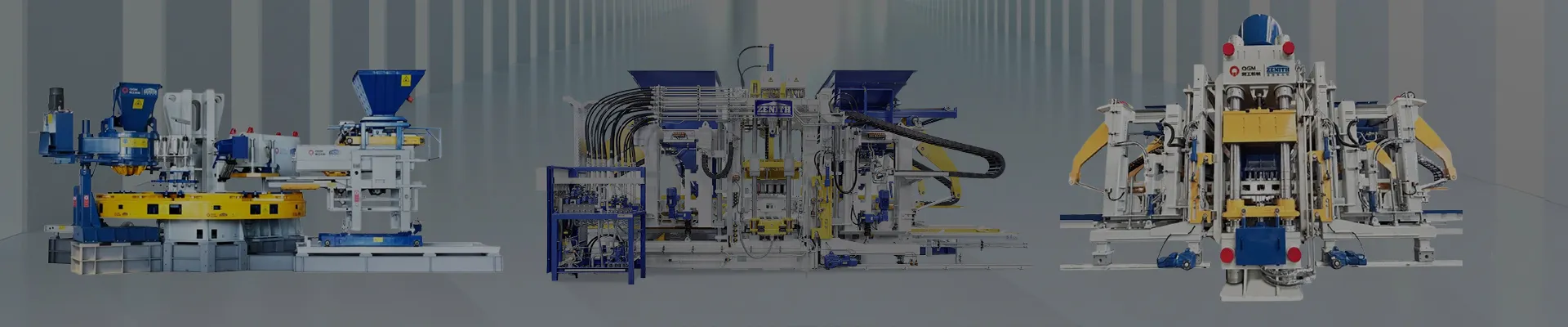
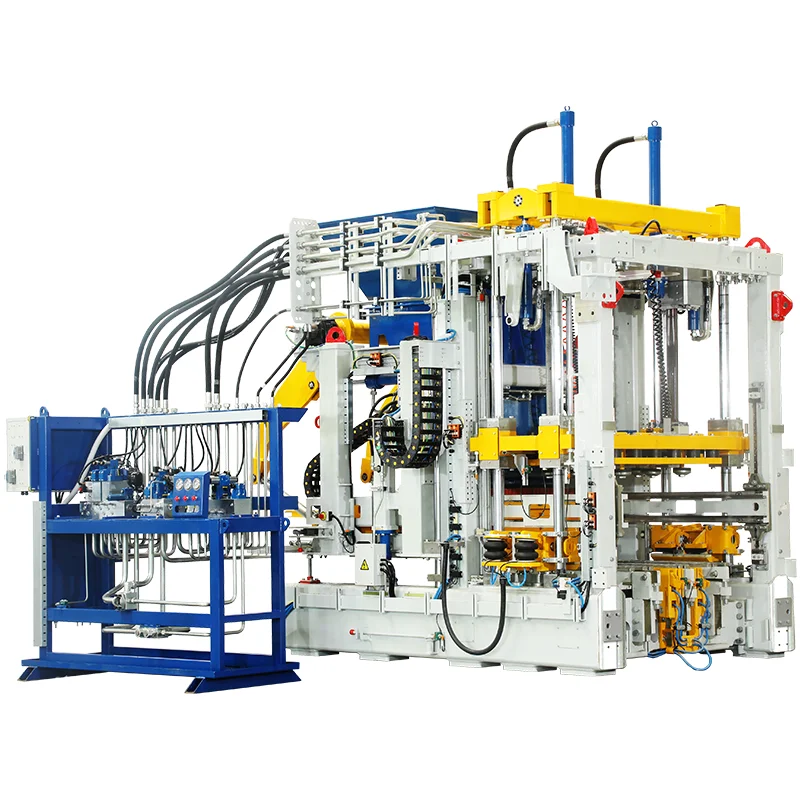
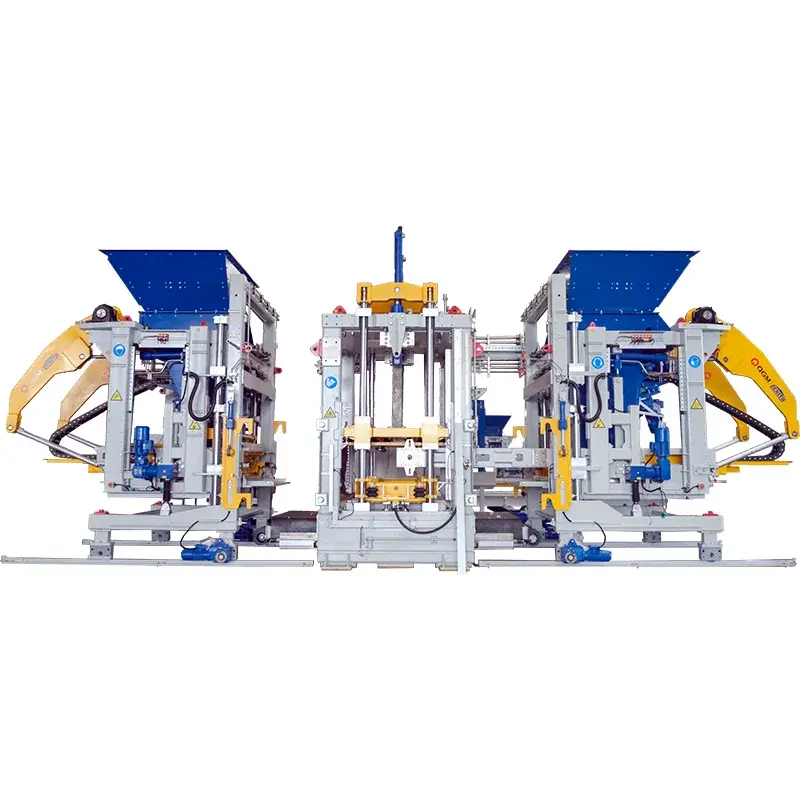
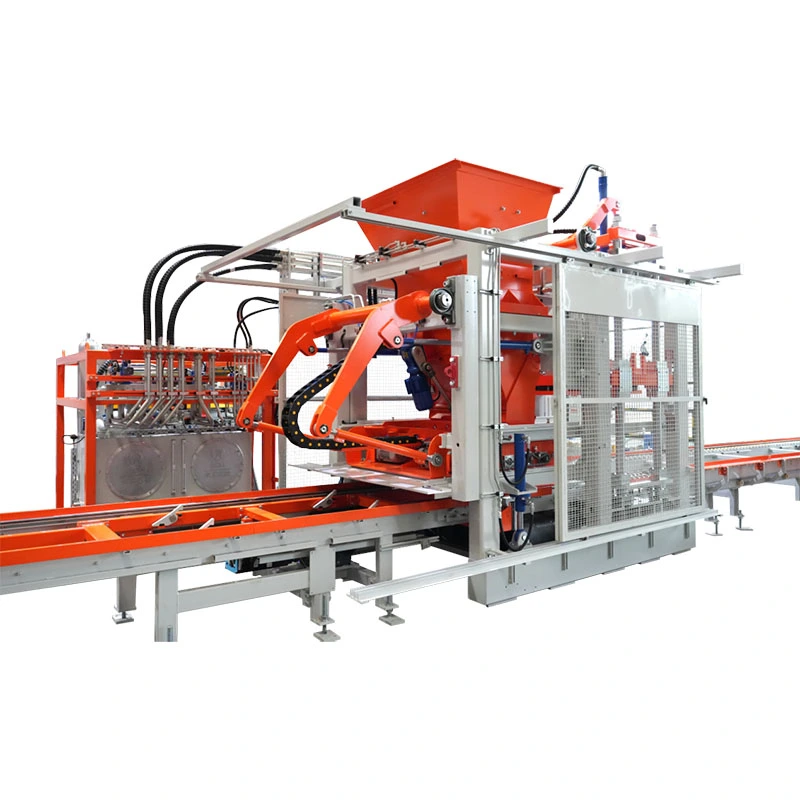
Automatic Block Production Line
Our manufacturing solutions encompass a complete range of block forming systems, from entry-level setups to high-capacity industrial configurations. The Simple Block Making Production Line provides a reliable foundation for small to medium operations, delivering consistent output with straightforward controls. For processors seeking enhanced automation and throughput, the Fully Automatic Block Making Production Line integrates intelligent PLC management, automatic material feeding, and synchronized pressing cycles. The core Fully Automatic Block Production-Line introduces closed-loop hydraulic systems and multi-layer stacking capabilities that significantly reduce labor dependency. For operations that demand accelerated curing and continuous output, the Fully Automatic Block Production Line with Curing Rack incorporates a dedicated rack handling system, enabling automatic loading and unloading of curing chambers while maintaining precise environmental control throughout the post-forming phase.
The Automatic Block Production Line redefines efficiency by merging high-frequency vibration technology with servo-driven pallet circulation. Each station—from aggregate batching to finished product cubing—operates through a centralized interface that monitors moisture, compaction force, and cycle timing in real time. This architecture supports extended production runs with minimal operator intervention, achieving uniform density distribution across all block formats. The line accommodates varying raw material blends, including fly ash, quarry dust, and recycled aggregates, without reconfiguration downtime. Integrated safety interlocks and predictive maintenance alerts further contribute to consistent uptime, while the modular design allows future expansion with additional molds, stackers, or packaging modules.
Key Product Parameters
- Pallet size: 880×550 mm to 1100×700 mm (mold-dependent)
- Block types: hollow, solid, paving, curbstone, interlocking
- Vibration system: twin-shaft synchronous, adjustable frequency 0–60 Hz
- Hydraulic unit: 15 kW–22 kW, pressure range up to 21 MPa
- Mold change time: under 15 minutes with quick-release clamps
- Control platform: Siemens PLC with touchscreen HMI, remote diagnostics
- Concrete hopper volume: 800–1200 L, equipped with moisture sensors
- Curing transport: automatic finger car or rack handling, 12–24 chambers
- Power supply: 380V/50Hz or 440V/60Hz, customizable
- Air consumption: 0.6–0.8 MPa for cleaning and pallet oiling
Performance Specifications for Common Models
| Parameter |
Benchmark 8 Station |
High-Output 15 Station |
Curing-Rack Integrated |
| Cycle time (hollow block) |
18–20 seconds |
12–15 seconds |
14–16 seconds |
| Output per shift (8 hours) |
9,600–11,200 blocks |
19,200–24,000 blocks |
21,600–28,800 blocks |
| Installed power |
38 kW |
62 kW |
75 kW |
| Machine weight |
14 tons |
22 tons |
28 tons |
| Block height range |
50–250 mm |
40–300 mm |
40–300 mm |
| Pallet storage capacity |
500 pallets |
1,200 pallets |
1,500 pallets (rack) |
| Steam curing compatibility |
Optional |
Integrated |
Fully automated with racks |
| Noise level at operator station |
< 82 dB(A) |
< 80 dB(A) |
< 78 dB(A) |
The hydraulic pressing head achieves compaction forces exceeding 120 kN, ensuring raw material consolidation that meets ASTM C90 and EN 771 standards. Dual-axis vibration tables generate a vertical acceleration of up to 12 g, while horizontal oscillation minimizes voids in the block core. All contact surfaces are manufactured from heat-treated wear steel with a Brinell hardness above 500 HB, reducing maintenance intervals. The automatic pallet feeding system operates through a friction-driven transfer car that positions stacks with ±1 mm repeatability, supported by laser alignment sensors at each critical junction.
The batching and mixing subsystem includes twin-shaft compulsory mixers with a batch volume of 1.0–1.5 m³, capable of preparing zero-slump concrete within 90 seconds. Aggregate dosing via belt weigh feeders and cement silo integration are governed by a recipe management database that stores over 100 mix designs. Water addition is controlled by an inline microwave moisture meter, maintaining consistency within ±0.3% of target water-cement ratio. After forming, fresh blocks are transported by a pallet return conveyor to the elevator station, where a robotic finger system transfers them onto curing racks without surface marking.
The curing rack configuration utilizes galvanized structural frames rated for 2,000 kg per level. Environmental sensors within the curing chamber maintain temperature at 35–70 °C with humidity above 90% RH throughout the steam or low-pressure steam cycle. Rack movement is executed by a rail-guided shuttle that can index positions within 2 mm, allowing precise alignment with the downstream cubing robot. This integrated handling eliminates the need for manual block removal during the 4–24 hour curing window, preserving dimensional accuracy and edge sharpness across all product lines.