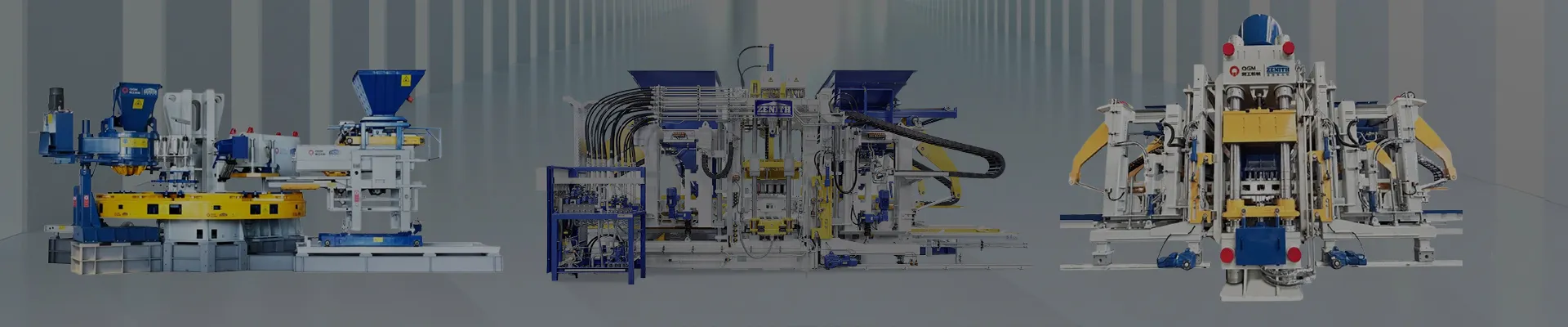
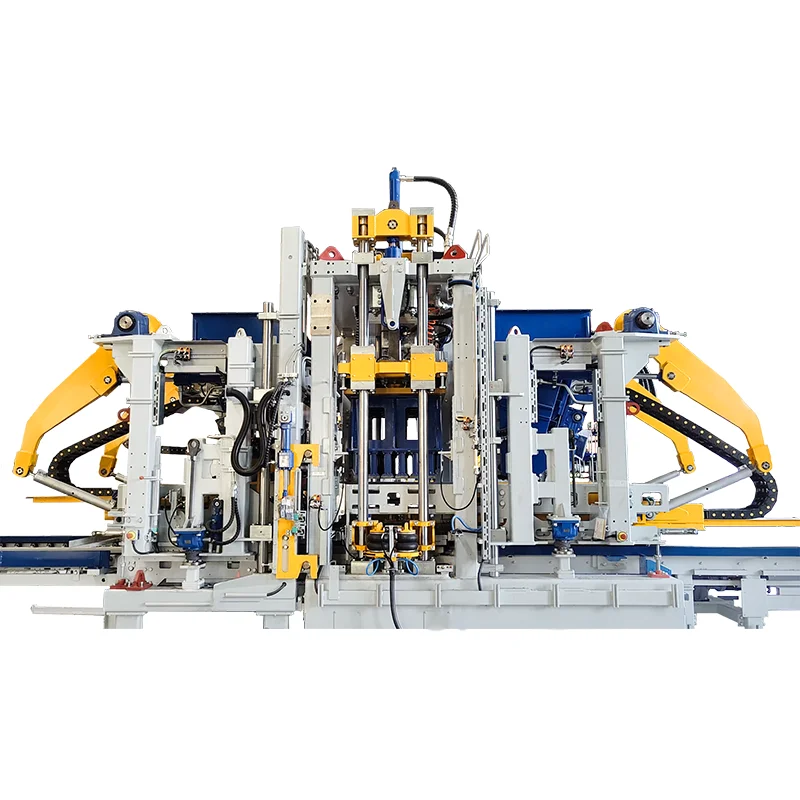
brick making production lines
In the competitive construction materials industry, efficiency and consistency are everything. Modern brick manufacturing demands equipment that minimizes downtime while maximizing output quality. Our engineering team has developed a versatile range of solutions that cater to different scales of operation. Whether you are expanding an existing facility or building a new plant from the ground up, you will find the right fit among our fully automatic production line for brick making, which handles every stage from raw material dosing to cubing with minimal human intervention. For operations that require uncompromising precision and speed, the brick making fully automatic production line integrates advanced servo-driven presses and robotic palletizers to ensure every brick meets strict dimensional tolerances. If you need multiple coordinated units working in parallel, our brick making fully automatic production lines are designed for seamless scalability, allowing you to double or triple capacity without compromising process control. And for businesses evaluating the transition from semi-automated methods, the brick making automatic production line provides an ideal entry point, delivering significant labor reduction and repeatable quality at a compelling investment level.
The <产品名字> is built around a modular chassis concept, enabling rapid reconfiguration for different brick sizes and shapes. Its integrated control system monitors mixture moisture, hydraulic pressure, and curing temperatures in real time, automatically adjusting parameters to maintain optimal production conditions. This level of intelligence reduces the learning curve for operators and virtually eliminates batch-to-batch variation. The heavy-duty steel frame absorbs vibration during high-speed pressing, contributing to the system’s unusually long service life even under continuous three-shift operation. Maintenance points are grouped and accessible at ground level, cutting routine service time by up to 40% compared to previous generations. Every <产品名字> unit ships with a comprehensive remote diagnostics package, connecting your plant floor directly to our support engineers for proactive troubleshooting.
Core Specifications and Performance Metrics
Each brick making production line is configured to meet specific output requirements, raw material characteristics, and site constraints. Below we outline the standard parameters that define the system’s capability range. All data is based on standard concrete brick formulations with aggregates typical of commercial operations.
- Production capacity: 8,000 to 57,600 bricks per 8-hour shift (depending on mold configuration and material handling speed)
- Cavity configurations: 4 to 18 bricks per pressing cycle for hollow blocks, 12 to 36 for solid bricks
- Installed power: 45 kW to 210 kW, with energy recovery options available for the hydraulic circuit
- Automation level: Fully automatic material batching, mixing, pressing, rack curing, cubing, and packaging
- Control system: PLC-based with 12-inch color touch screen, recipe storage for 200+ product types, Ethernet/IP and MODBUS TCP connectivity
- Pressing force: 800 kN to 2,200 kN, adjustable in 10 kN increments via software
- Cycle time: As low as 12 seconds for dry-cast hollow bricks, 18 seconds for solid paving bricks
- Noise level: Below 78 dB(A) at the operator station when fully enclosed
- Footprint: Standard configuration starts from 35 m × 12 m, expandable for additional curing and cubing modules
- Compliance: CE, ISO 9001 manufacturing, optional UL certification for North American installations
Detailed Technical Comparison Table
| Parameter |
Standard Line |
High-Capacity Line |
Twin Press Configuration |
| Max output (8hr shift) |
14,400 bricks |
28,800 bricks |
57,600 bricks |
| Main press power |
90 kW |
132 kW |
2 × 110 kW |
| Mold change time |
15 minutes |
12 minutes |
10 minutes per press |
| Vibration system |
Dual electric motors |
Servo-hydraulic |
Independent servo per press |
| Curing rack capacity |
4,800 bricks |
9,600 bricks |
18,000 bricks |
| Compressed air requirement |
8 bar, 1.2 m³/min |
8 bar, 2.0 m³/min |
8 bar, 3.5 m³/min |
| Typical installation time |
12 working days |
18 working days |
22 working days |
| Remote access standard |
Yes |
Yes, with predictive analytics |
Yes, with full automation dashboard |
Material Handling and Quality Control Integration
The aggregate handling system begins with a star-type feeding bin design that accurately meters up to six different materials by weight. A continuous twin-shaft mixer blends powders and liquids to a homogeneous consistency, discharging directly above the press hopper. The pressing unit uses a three-stage vibration pattern—pre-vibration, main compaction, and post-vibration—to achieve uniform density throughout the brick body. Automated height measurement immediately after pressing rejects any part falling outside programmable thickness limits, with tolerance typically set at ±0.5 mm. After pressing, a robotic gripper transfers complete layers onto curing racks. Moisture and temperature sensors inside the curing chambers maintain conditions specified in the recipe, and the system automatically adjusts dwell time based on real-time humidity readings. Once curing is complete, the bricks pass through a dry cubing station where a clamping robot assembles packs without using straps, protecting surface texture. Every hour of production generates a detailed quality report accessible through the main interface or a remote web portal. This integrated approach to material handling and quality verification ensures that the finished product consistently exceeds the requirements of ASTM C55, EN 771-3, and other international standards without the need for post-production rework.