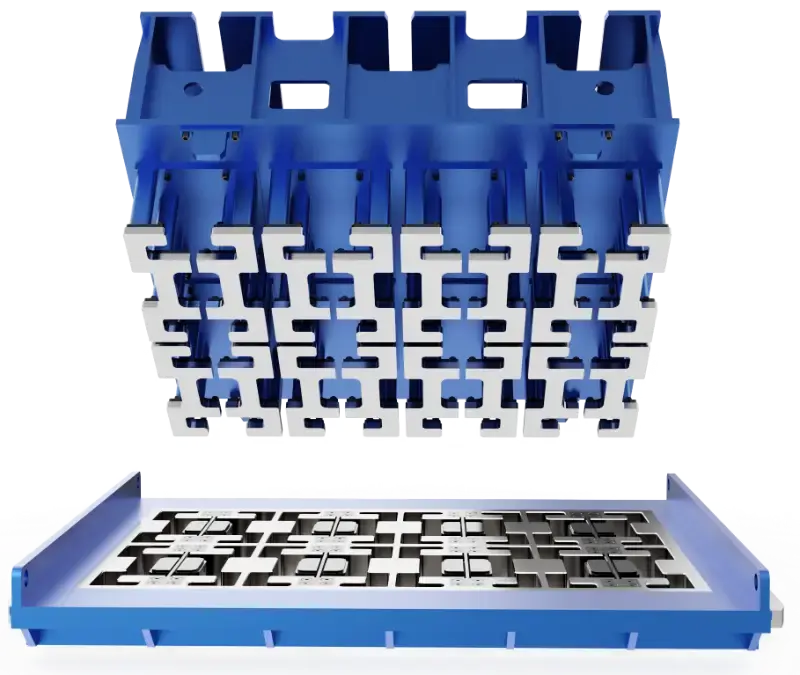
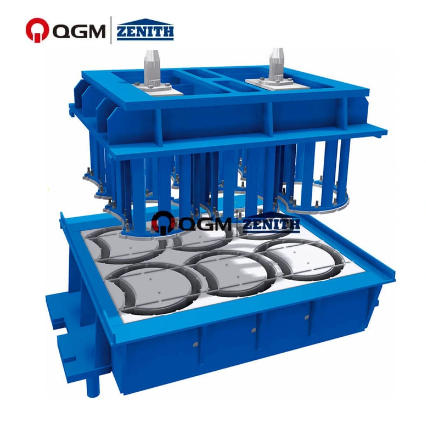
In a modern concrete block plant, the mold is more than a forming tool. It is one of the key components that determines product geometry, dimensional consistency, surface quality, and production flexibility.
A single block making machine can manufacture different concrete products by changing the mold, including hollow blocks, solid blocks, concrete paving blocks, curbstones, grass pavers, and slope protection blocks. This makes mold selection particularly important for manufacturers looking to expand their product range or improve the utilization of an existing concrete block production line.
However, choosing a suitable concrete block mold is not simply a matter of selecting the right product size. Mold design, material, manufacturing precision, machine compatibility, production requirements, and long-term operating costs all need to be considered together.
During the forming process, the mold is continuously exposed to aggregate contact, vibration, compression, and demolding forces. At the same time, it determines the final shape and dimensions of the concrete product.
For this reason, the performance of the mold can directly influence:
* Product dimensions and geometry
* Cavity configuration and wall thickness
* Edge and surface quality
* Production consistency
* Mold service life
* Machine utilization
* Product changeover flexibility
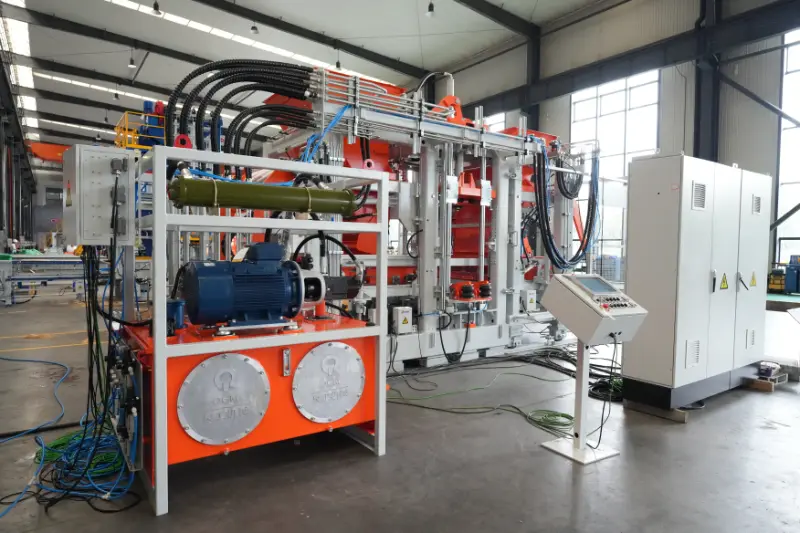
A well-designed mold should therefore work together with the concrete block machine, material feeding system, vibration system, and demolding process rather than being considered as an independent accessory.
The most appropriate mold depends first on the type of concrete product being produced.
Typical applications include:
* Hollow concrete blocks
* Solid concrete blocks
* Concrete paving blocks
* Curbstones
* Grass pavers
* Slope protection blocks
* Special-format concrete products
Different products require different mold structures and forming configurations. Hollow blocks, for example, require suitable cavity arrangements and wall thicknesses to achieve the required product structure. Paving blocks place greater emphasis on dimensional accuracy, surface finish, texture, and visual consistency.
Before selecting a block machine mold, manufacturers should therefore define their target products and market requirements first. The mold can then be designed around the required product specifications and production process.
Concrete block dimensions are not universal. Product sizes, cavity configurations, wall thicknesses, and other specifications can vary between countries and regions depending on local construction standards and market preferences.
For this reason, simply ordering a mold based on a commonly used "standard size” may not provide the best solution.
Mold selection should instead consider several factors together:Product specifications + machine model + blocks per mold + target production capacity.This approach helps ensure that the mold is suitable not only for the finished product, but also for the required production output.
For manufacturers planning to produce multiple block sizes or expand their product portfolio, an automatic block production line with flexible mold-change capability can provide greater production versatility. Different molds can be used on the same production system, allowing manufacturers to respond to changing market demand without replacing the complete line.
A concrete block mold operates under demanding production conditions. Repeated contact with aggregates, continuous vibration, compression forming, and demolding can gradually cause wear and fatigue.
The choice of mold material and manufacturing process therefore has a direct influence on service life.
A reliable concrete block mold should generally provide:
* High wear resistance
* Adequate structural strength
* Stable dimensional accuracy
* Good fatigue resistance
* Appropriate heat treatment
This becomes particularly important for high-volume production or applications involving hard aggregates and recycled solid waste materials.
If the mold wears excessively, cavity dimensions may change over time, potentially affecting block geometry, product consistency, and forming quality. For this reason, mold durability should be evaluated according to the actual production environment rather than based solely on its initial purchase price.
The mold defines the physical geometry of the finished concrete product, but its influence extends beyond basic dimensions.
Mold manufacturing accuracy affects how the concrete mix is distributed within the cavities and how consistently the product is formed. A precisely manufactured mold can help maintain stable:
* Product dimensions
* Edge geometry
* Cavity accuracy
* Surface quality
In an automated concrete block production line, mold accuracy can also influence material feeding, vibration forming, demolding, and downstream palletizing.
This is why mold precision should be evaluated alongside the technical performance of the main block making machine.
Even a high-quality mold cannot perform properly if it is not correctly matched to the block making machine.
Different machines can have different requirements for mold dimensions, mounting methods, forming height, available forming space, and mold weight.
Before confirming a mold solution, manufacturers should verify:
* Overall mold dimensions
* Mold mounting configuration
* Required forming height
* Number of products per mold
* Mold weight
* Demolding requirements
* Mold replacement procedure
Proper compatibility helps the machine and mold operate as an integrated forming system. Poor matching, by contrast, can lead to production interruptions, lower efficiency, or inconsistent product quality.
For manufacturers operating a concrete product plant over the long term, mold engineering is closely connected with production performance and operating costs.
QGM has dedicated R&D and manufacturing capabilities for concrete block molds and can develop mold solutions based on the machine model, product specifications, and production requirements.
The process can involve mold structure design, material selection, machining, and heat treatment. These factors can be adjusted according to different products and operating conditions to support consistent forming performance and an appropriate service life.
QGM mold solutions can be used for a range of concrete products, including:
* Hollow blocks
* Solid blocks
* Concrete paving blocks
* Curbstones
* Grass pavers
* Slope protection blocks
* Special-format concrete products
For projects requiring non-standard dimensions, cavity configurations, or product structures, mold solutions can also be developed based on product drawings, target market requirements, and the specifications of the existing block making machine.
For an established concrete block plant, mold selection also determines how flexibly the production line can respond to different market requirements.
When an automatic block making machine supports efficient mold changes, manufacturers can use the same production system to manufacture different products and sizes without replacing the complete production line.
A practical mold selection process can therefore follow this sequence:Define the product → Confirm product dimensions → Match the machine → Select mold material → Verify manufacturing precision → Validate production capacity.
Planning future mold requirements at the equipment selection stage can also make it easier to introduce additional products later and improve overall equipment utilization.
Initial purchase price is an important consideration, but it should not be the only factor used to compare concrete block molds.
A low-cost mold with poor wear resistance or inconsistent manufacturing precision may require more frequent replacement and can affect production quality. The resulting replacement costs, downtime, and production losses may outweigh the initial savings.
A more complete evaluation should consider:
* Initial mold cost
* Expected service life
* Wear resistance
* Manufacturing precision
* Machine compatibility
* Mold-change efficiency
* Product forming quality
* Long-term maintenance costs
For continuous-production concrete product manufacturers, the most economical mold is not necessarily the one with the lowest purchase price. It is the mold that can maintain reliable performance throughout its operating life while supporting stable production.
Selecting a concrete block mold is not simply about finding a mold that fits onto a machine. A suitable solution needs to bring together product requirements, machine compatibility, mold construction, manufacturing precision, production capacity, and long-term operating costs.
For manufacturers producing hollow blocks, solid blocks, paving blocks, curbstones, grass pavers, or slope protection blocks, a properly engineered and accurately matched mold can contribute to consistent product dimensions and appearance while improving the flexibility of the concrete block production line.
The most effective approach is therefore to evaluate the mold from four perspectives: product requirements, machine compatibility, mold performance, and lifecycle cost. With the right mold design and machine matching, one concrete block production system can support a wider product range while maintaining efficient and stable concrete product manufacturing.
The right concrete block mold should be selected according to the product type, product dimensions, block making machine model, required production capacity, mold material, and target market requirements.
Mold manufacturing precision directly affects product dimensions, cavity accuracy, edge geometry, surface quality, and overall product consistency. It can also influence material feeding, vibration forming, demolding, and palletizing in an automated concrete block production line.
The mold should be matched according to the machine's mold dimensions, mounting configuration, forming height, mold weight, blocks produced per cycle, and demolding requirements. Proper compatibility helps maintain stable machine operation and consistent product quality.
Mold material, wear resistance, manufacturing precision, heat treatment, aggregate characteristics, production frequency, vibration, and demolding conditions can all affect mold service life. Applications using hard aggregates or recycled solid waste materials require particular attention to mold wear resistance.
Yes. If the automatic block making machine is designed for flexible mold changes, the same production line can use different molds to manufacture hollow blocks, solid blocks, paving blocks, curbstones, grass pavers, slope protection blocks, and other concrete products. This can improve equipment utilization and production flexibility.
-