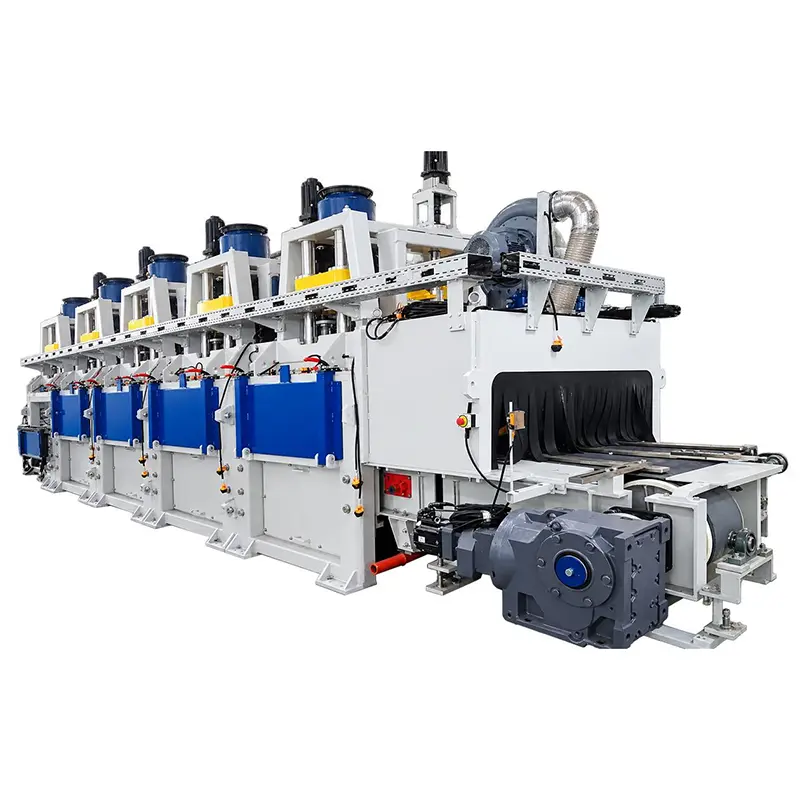
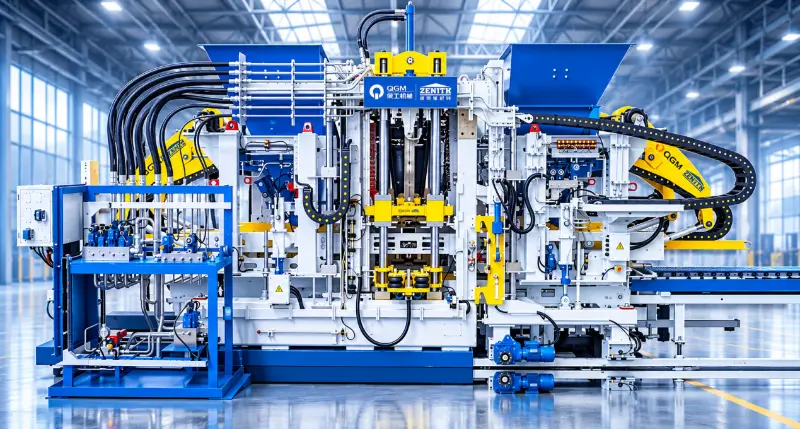
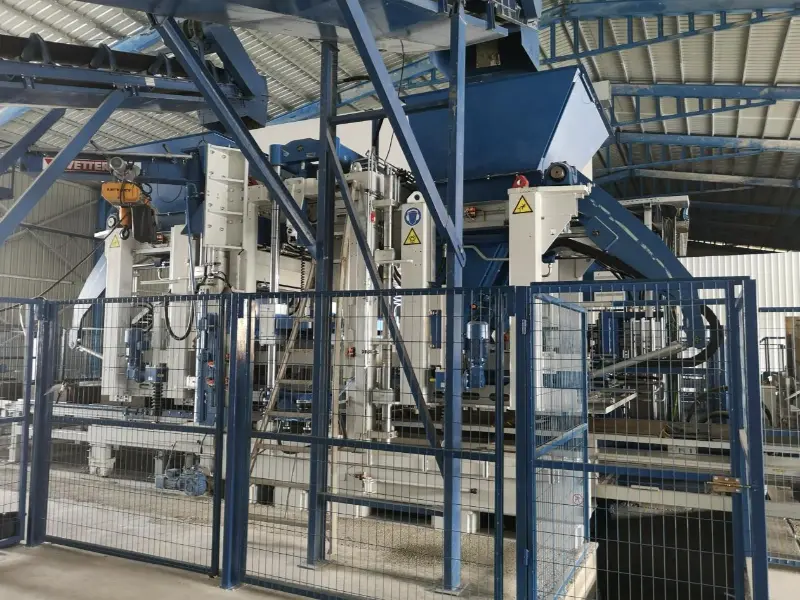
The Concrete Block Calibration and Grinding Machine combines backside thickness calibration, automatic 180-degree turning, and front-surface grinding. Designed for curbstones, paving slabs, and paving stones, it supports dimensional correction and surface finishing, with optional polishing.
In precast concrete manufacturing, some products require additional processing after forming to achieve the specified thickness and surface finish. The Concrete Block Calibration and Grinding Machine is designed to handle these downstream operations by combining thickness correction and surface treatment in one coordinated system.
The machine integrates back-surface thickness calibration with front-surface grinding, connected by an automatic 180-degree product turning device. This arrangement allows both processing stages to be carried out in sequence. An optional polishing function is also available for concrete products that require further surface refinement.
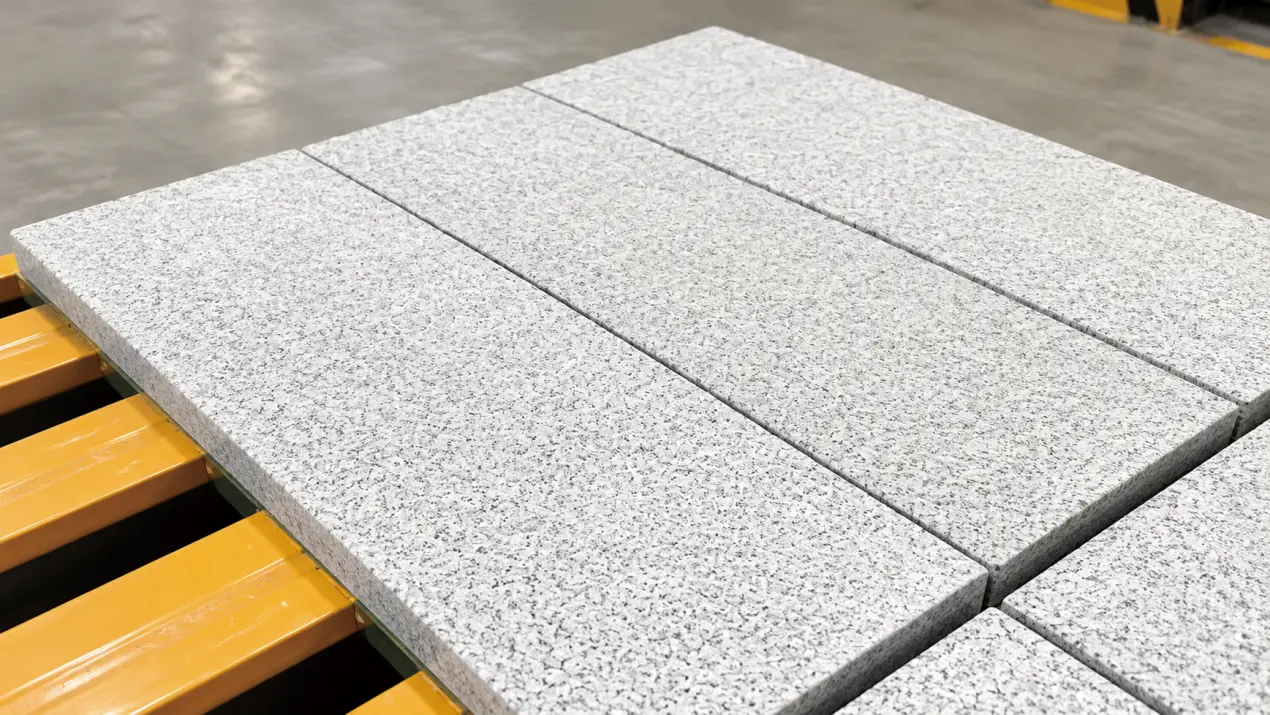
Suitable for concrete curbstones, paving slabs, paving stones, and other compatible precast concrete products, the Concrete Block Calibration and Grinding Machine provides an integrated solution for dimensional correction and surface finishing. Its coordinated processing arrangement helps manufacturers handle different finishing requirements within their production workflow.
When selecting the Concrete Block Calibration and Grinding Machine, manufacturers should consider the required product thickness, the surface condition after forming, the desired final appearance, and compatibility with the existing production line.
Key Advantages
1. Correcting Thickness on the Back Surface
The first stage focuses on thickness calibration. A cutting head removes excess material from the back surface, helping bring the product closer to its specified thickness.
A second head then smooths the calibrated surface. This additional operation helps reduce rough pressing marks and surface waviness that may remain after the initial forming process.
The two-head arrangement separates initial material removal from subsequent surface refinement, providing a defined sequence for back-surface treatment.
2.Turning the Product for the Next Operation
After back-surface calibration, an automatic turning device rotates the product 180°. The opposite surface is then positioned for front-surface grinding.
This turning mechanism links the two processing stages and reduces the need to handle the product as a separate turning operation between calibration and grinding.
When assessing how this arrangement fits a production line, manufacturers should confirm the product dimensions and handling requirements with the equipment supplier.
3. Grinding the Front Surface in Stages
The front surface passes through multiple grinding stations, with the process progressing from rough grinding to finer grinding.
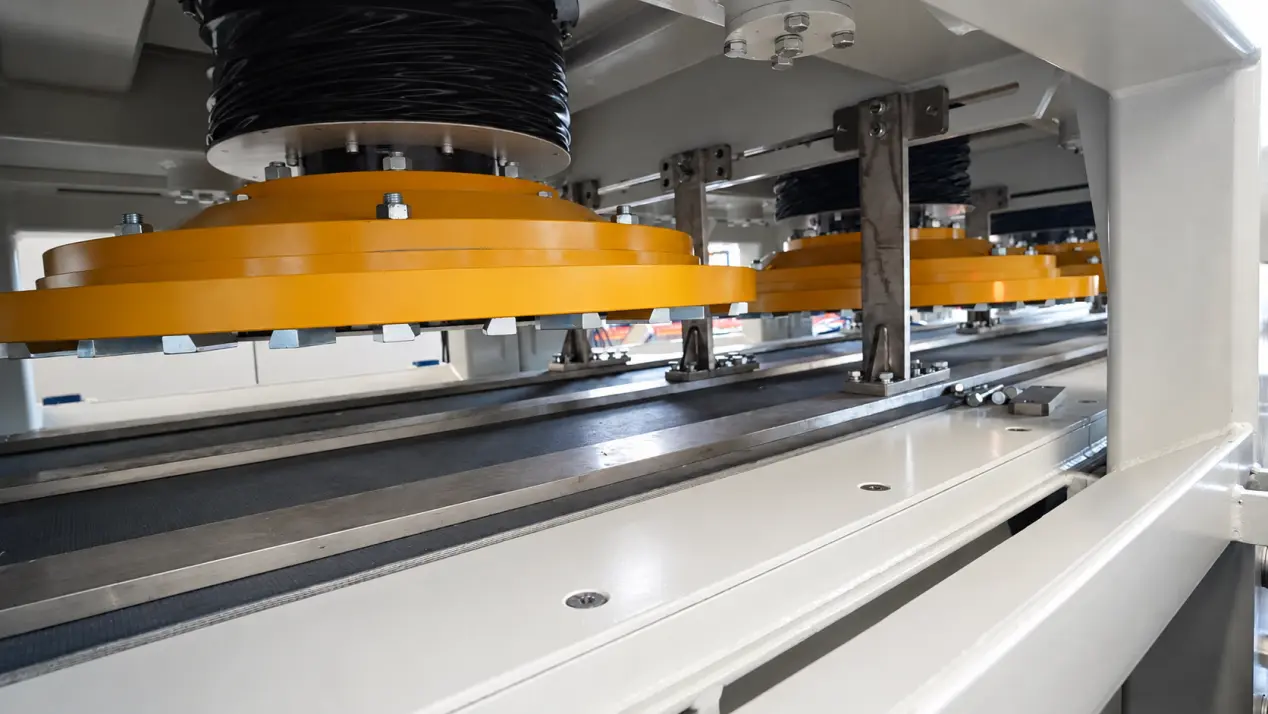
Large-diameter grinding discs help minimize wave-like surface defects and maintain flatness across the working width. The staged arrangement allows the surface to be refined progressively rather than relying on a single grinding stage.
For concrete paving products and other precast components, the selected grinding sequence should correspond to the intended surface finish and the characteristics of the product being processed.
4. Adding Polishing When Required
Some products require additional surface refinement beyond grinding. For these applications, the machine can be equipped with an optional polishing stage.
Polishing is not a mandatory step for every product. Its use depends on the finishing requirements of the application.
This optional configuration gives manufacturers the flexibility to select a suitable process sequence for products with different surface-quality expectations.
5.Process Control for Different Finishing Requirements
Concrete products can vary in dimensions, surface condition, and finishing requirements. The machine incorporates several control functions to support the management of these processing tasks.
Contact-Pressure Control
Adjustable contact pressure supports control of the interaction between the processing components and the concrete product during finishing.
HMI and Recipe Management
The human-machine interface (HMI) provides an operating interface for managing the process. Recipe management allows settings to be organized according to different finishing requirements.
Dry and Wet Processing Modes
Both dry and wet processing modes are supported. The appropriate mode can be selected according to the intended application and process configuration.
Together, these functions provide a structured approach to managing the calibration and grinding sequence.
For consistent operation, manufacturers should establish suitable processing settings for each product type and verify that the selected parameters match the required finishing results.
6.Concrete Products and Finishing Applications
The machine is designed for compatible precast concrete products that require thickness calibration, surface grinding, or optional polishing.
Concrete Curbstones
The calibration stage corrects excess material on the back surface, while subsequent grinding supports the required surface treatment.
Concrete Paving Slabs
Thickness calibration and grinding can be used to address dimensional variation and improve surface flatness.
Concrete Paving Stones
The multi-stage grinding process provides progressive surface refinement, with optional polishing available where additional finishing is required.
Other Precast Concrete Components
Products with compatible dimensions and processing requirements can be evaluated for use with the machine.
The final machine configuration should be selected according to the actual product range rather than the product name alone. Drawings, dimensions, surface requirements, and processing conditions provide a more reliable basis for technical evaluation.
Selecting a Concrete Block Grinding Solution
When evaluating a concrete block grinding machine, manufacturers should consider more than the general equipment category. The machine's calibration arrangement, grinding configuration, product-turning method, and available process controls all affect its suitability for a particular finishing application.
The QGM Concrete Block Grinding and Surface Finishing Machine combines:
•Dual-head back-surface thickness calibration.
•Large-diameter grinding discs designed to minimize wave-like defects.
•Automatic 180-degree product turning.
•Multi-stage front-surface grinding.
•Optional polishing.
•Contact-pressure control and HMI-based operation.
•Recipe management and dry or wet processing modes.
These functions provide an integrated equipment solution for manufacturers processing concrete curbstones, paving stones, paving slabs, and other compatible precast concrete products.
Contact QGM to discuss your product specifications and surface-finishing objectives. The technical team can evaluate equipment suitability based on the intended products and processing requirements.
If you have any enquiry about quotation or cooperation, please feel free to email or use the following inquiry form. Our sales representative will contact you within 24 hours.
We use cookies to offer you a better browsing experience, analyze site traffic and personalize content. By using this site, you agree to our use of cookies. Privacy Policy