In concrete block production, manufacturers often focus on the vibration system, hydraulic system, and automation level of the block making machine. However, one critical component directly involved in product forming is sometimes overlooked—the concrete block mold.
In fact, mold quality has a direct impact on block dimensional accuracy, cavity consistency, edge integrity, and surface finish. For manufacturers running continuous production, a mold's wear resistance and service life can also affect production efficiency, mold change frequency, and overall manufacturing costs.
A truly high-quality concrete block mold is not simply a piece of steel that has been machined into shape. It is the result of a controlled manufacturing process that includes material selection, pre-machining, precision machining, heat treatment, surface finishing, assembly, hardness testing, and trial molding. Each stage affects the final performance of the mold and determines whether it can maintain stable performance under high-frequency, long-term production conditions.
Concrete block molds are continuously exposed to vibration, compression, demolding, and aggregate abrasion during production. Material selection is therefore a key factor in determining mold durability and service life.
High-quality molds generally use alloy steel with high strength, hardness, and wear resistance. The material must withstand repeated mechanical impact while maintaining dimensional stability over extended production periods. For this reason, mold manufacturing begins with selecting the right material according to the product type, equipment operating conditions, and production intensity.
When concrete products are manufactured using high-hardness aggregates or other highly abrasive materials, mold wear can become more significant, creating higher demands on material wear resistance.
Once the material has been selected, proper cutting, sizing, and pre-machining are carried out to establish a stable dimensional foundation for subsequent precision machining.
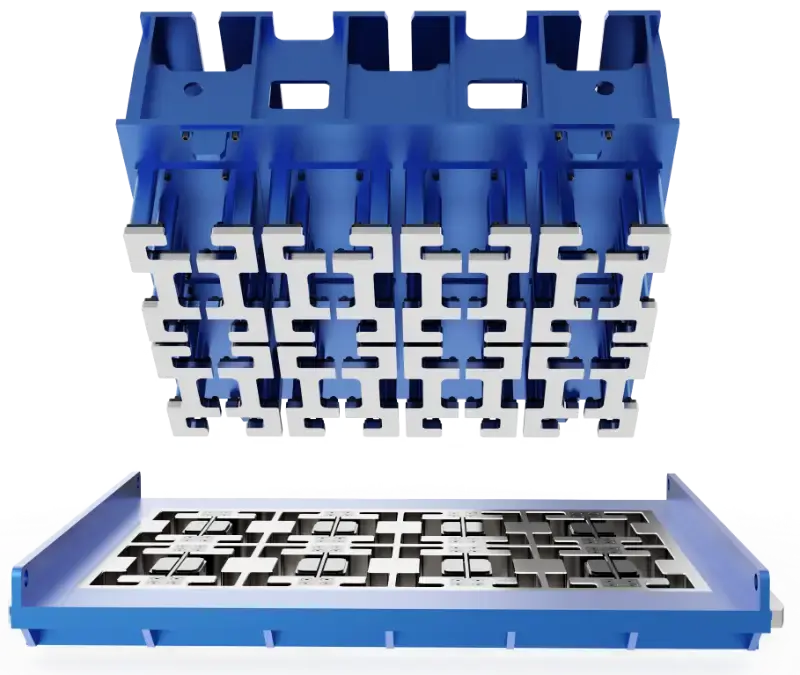
A concrete block mold consists of mold cavities, cores, frames, and multiple critical fitting areas. Significant dimensional deviations in these components can result in inconsistent block dimensions, misaligned cavities, irregular edges, and other forming defects.
During mold manufacturing, precision processes such as CNC milling and wire cutting are used to control critical dimensions and fitting tolerances accurately.
For high-precision concrete block molds, critical areas can be controlled within ±0.3 mm. Consistent machining accuracy helps maintain uniformity between individual cavities, allowing concrete blocks produced within the same batch to achieve more consistent dimensions and appearance.
This consistency is particularly important for automatic block making machines and concrete block production lines. Mold accuracy affects not only the finished product but also processes such as material feeding, vibration compaction, demolding, and subsequent stacking.
If precision machining determines how accurately a mold is manufactured, heat treatment determines how well it can maintain that accuracy over time.
During concrete block production, molds are repeatedly subjected to aggregate abrasion, machine vibration, and demolding forces. Relying solely on the properties of conventional steel makes it difficult to withstand the wear associated with high-frequency, continuous production over the long term.
Therefore, appropriate heat treatment based on the material and mold structure is an important process for improving surface hardness, wear resistance, and service life.
Common processes include carburizing and nitriding. Targeted heat treatment can improve surface hardness and wear resistance while maintaining the toughness of the overall structure, allowing the mold to better withstand repeated impact and friction during production.
For continuously operating automatic block production lines, stable wear resistance helps minimize dimensional changes and product quality fluctuations caused by mold wear.
The condition of the mold surface directly affects contact between the concrete mix and the mold cavity, as well as the demolding process. Visible machining marks, burrs, or uneven areas can affect product surface quality and may increase resistance during demolding.
For this reason, critical mold surfaces are finely ground and polished during the later stages of manufacturing to achieve a more consistent surface condition.
For concrete products with higher appearance requirements, such as paving blocks, stone-look blocks, and grass pavers, surface finishing becomes even more important. A stable and well-finished mold cavity helps maintain consistency in product texture, dimensions, and appearance.
Completing the machining process does not mean that mold manufacturing is finished. A complete concrete block mold usually consists of multiple structural components, and these components must maintain accurate dimensional relationships and assembly tolerances.
If deviations occur during assembly, the overall mold performance may be affected even when the individual components meet their machining requirements.
During assembly, critical connection points, mold cavities, and fitting areas must therefore be inspected to ensure that all components maintain the required fit and alignment.
For multi-cavity molds, particular attention should also be given to consistency between individual cavities. This helps prevent dimensional differences between concrete blocks produced by different cavities within the same mold.
For concrete block molds designed for long-term use, final inspection is an essential part of quality control.
After manufacturing and assembly, the mold should undergo appropriate inspections covering dimensional accuracy, critical component conditions, and material hardness.
Hardness testing helps verify whether the heat treatment has achieved the intended result, while dimensional inspection confirms that the mold cavities and other critical machined areas meet design requirements. Where conditions permit, trial molding can provide an additional level of validation.
Actual forming tests can be used to evaluate the compatibility between the mold and the block making machine, while checking product dimensions, cavity geometry, edge integrity, and surface condition.
Only after the necessary inspections and validation should the mold be put into actual production with greater confidence.
A well-designed concrete block mold with stable machining accuracy and good wear resistance can help manufacturers maintain more consistent control over:
●Block dimensional consistency
●Cavity and wall-thickness accuracy
●Edge integrity
●Surface quality
●Forming stability
●Mold service life
For concrete products manufacturers operating continuous production, significant mold wear can lead to product quality fluctuations while increasing scrap rates, mold replacement frequency, and maintenance costs.
The mold is therefore more than a simple accessory for a block making machine. It is an important component that determines how effectively the forming capabilities of the equipment can be translated into consistent finished-product quality.
From high-strength alloy steel selection to precision cutting and pre-machining, followed by CNC milling, wire cutting, heat treatment, surface polishing, assembly, final inspection, and trial molding, the production of a high-quality concrete block mold involves multiple controlled manufacturing stages.
A significant deviation at any stage can affect the mold's final performance.Therefore, what matters when evaluating a mold is not simply whether its appearance looks refined, but the manufacturing quality behind it—including material selection, machining accuracy, heat treatment, assembly quality, and inspection procedures.
For manufacturers producing hollow blocks, solid blocks, paving blocks, stone-look blocks, grass pavers, and other concrete products, selecting high-quality molds that match the equipment and product requirements can provide a more reliable foundation for stable forming and long-term production.
A high-quality concrete block mold requires suitable alloy steel, precise machining, proper heat treatment, fine surface finishing, accurate assembly, and strict quality inspection. These factors work together to determine mold accuracy, wear resistance, forming stability, and service life.
Mold accuracy directly affects block dimensions, cavity consistency, wall thickness, edge integrity, and surface quality. High-precision machining helps ensure consistent concrete blocks throughout continuous production.
High-quality concrete block molds generally use alloy steel with high strength, hardness, and wear resistance. Material selection should be based on the block type, equipment operating conditions, production intensity, and abrasiveness of the aggregates.
Heat treatment processes such as carburizing and nitriding can improve the mold's surface hardness and wear resistance while maintaining the toughness of the overall structure. This helps the mold better withstand repeated vibration, friction, and demolding during production.
Trial molding helps verify the compatibility between the mold and the block making machine. It allows manufacturers to check block dimensions, cavity geometry, edge integrity, and surface condition before the mold enters actual production.